
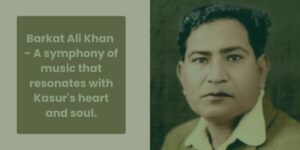
Barkat Ali Khan, a figure synonymous with the cultural heritage of Kasur, remains one of the district’s most influential figures. His name is etched in the annals of history as one of the most prominent classical singers of the Indian subcontinent. Known for his captivating voice and a unique ability to engross listeners, Barkat Ali Khan has left an indelible mark on the world of music. This article aims to delve into his life, tracing his journey from Kasur to the pinnacle of classical music fame.
Early Life
Barkat Ali Khan was born in 1908 in Kasur, a city known for its rich cultural heritage and for nurturing several renowned musicians and poets. He belonged to the Patiala Gharana, a prestigious lineage of musicians tracing its roots back to the court of the Maharaja of Patiala.
As a child, Barkat Ali Khan demonstrated a keen interest in music, a passion that was strongly encouraged by his family, known for their musical talents. He was initially trained by his father, Ali Bux Khan, who was a well-regarded vocalist in the court of Patiala.
Journey towards Music
With his father’s training forming the bedrock of his musical foundation, Barkat Ali Khan soon developed his unique style, combining the rigorous classical tradition with an instinctive sense of creativity. His talent quickly gained recognition, and he began his journey into the world of professional music.
It is important to highlight that Barkat Ali Khan’s journey was not devoid of challenges. The initial years of his career were marked by struggle and hard work. However, his tenacity and passion for music never waned. Barkat Ali Khan’s rise in the classical music sphere can be credited to his perseverance, coupled with his unmatched talent.
Musical Career and Achievements
Barkat Ali Khan’s musical career was a testament to his exceptional talent and the depth of his classical training. He specialized in a variety of genres, including thumri, dadra, kajri, and ghazal, exhibiting a profound understanding and command over each of them.
As his career progressed, Barkat Ali Khan performed at numerous concerts and music festivals, earning recognition and accolades for his mesmerizing performances. His rendition of thumris and ghazals was especially celebrated, earning him a distinctive place in the world of Indian classical music.
Barkat Ali Khan’s contributions were not limited to performance alone. He also worked to mentor and train future generations of musicians, thus ensuring the continuity and growth of the classical music tradition. Some of his most well-known disciples include Salamat Ali Khan and Nazakat Ali Khan, who went on to establish their own significant careers in music.
Later Years and Legacy
In the later years of his life, Barkat Ali Khan continued to be an active contributor to the classical music scene. Despite facing health issues, he never let his passion for music wane and continued to perform, record, and mentor young talents.
Barkat Ali Khan passed away in 1963, but his legacy continues to thrive. His recordings continue to be revered by classical music enthusiasts, and his contributions to the genre have been widely recognized by music scholars and historians. His life’s work has had a significant impact on the music scene in the Indian subcontinent and continues to inspire musicians.
In Kasur, his birthplace, Barkat Ali Khan’s name is synonymous with musical excellence. The city remembers him as one of its greatest sons, and his music continues to echo in the hearts of its residents. His story is a powerful reminder of the cultural richness of Kasur, a city that has nurtured numerous talents and contributed immensely to the world of music and arts.
Barkat Ali Khan’s life, work, and legacy are a testament to his extraordinary talent, the depth of his musical knowledge, and his unwavering dedication to his craft. He remains an icon of classical music, embodying the rich cultural heritage of Kasur. Through his music, he continues to live on, inspiring countless musicians and music lovers around the world.
Musical Style and Innovations
Barkat Ali Khan was well-versed in both the Dhrupad and Khayal styles of Indian classical music. His training under his elder brother Bade Ghulam Ali Khan further diversified his musical range, and he gained proficiency in the Patiala Gharana’s style. Barkat Ali Khan was particularly known for his thumris, a semi-classical form, wherein he skillfully incorporated the intricate techniques of Khayal singing.
Barkat Ali Khan had a deep understanding of raagdari music, enabling him to innovate within the structure of traditional raags. His performances often involved beautiful elaborations and explorations of the raag, combined with a robust and sonorous voice that had a wide range.
While Barkat Ali Khan is known for his thumris, he also made significant contributions to the ghazal genre. He modernized the traditional ghazal form by incorporating elements of light classical genres like the thumri and dadra into his performances. This innovative blending of genres not only made his ghazals popular but also significantly influenced the style of later ghazal singers.
Recognition and Honors
Throughout his career, Barkat Ali Khan earned several accolades and awards in recognition of his contributions to Indian classical music. Despite these honors, he remained a humble artist, consistently dedicated to his craft, and committed to promoting and preserving the classical music tradition.
In conclusion, Barkat Ali Khan, with his prodigious talent and dedication to his craft, truly earned his place as a legendary figure in Indian classical music. His contributions to the field continue to be celebrated, and his music continues to inspire new generations of musicians and music lovers. Even years after his death, Barkat Ali Khan’s legacy lives on, reinforcing Kasur’s status as a city with a rich musical heritage.
Frequently Asked Questions
Q: Who is Ustad Barkat Ali Khan?
A: Ustad Barkat Ali Khan was a famous Pakistani classical singer from Kasur (Pakistan), known for his contribution to Pakistani and Indian classical music.
Q: Is there any relation between Ustad Barkat Ali Khan and Bade Ghulam Ali Khan?
A: Yes, Ustad Barkat Ali Khan and Bade Ghulam Ali Khan were brothers. Barkat Ali Khan was the younger brother of Bade Ghulam Ali Khan, both being renowned classical singers.
Q: What is the biography of Ustad Barkat Ali Khan?
A: Ustad Barkat Ali Khan was born in Kasur, Pakistan. He was the younger brother of Bade Ghulam Ali Khan and Mubarak Ali Khan. He received his training from his father, Ali Baksh Khan, who was also a renowned classical singer.
Q: What’s the significance of Lahore when speaking about the Barkat Ali Khan biography?
A: Lahore is significant in the Barkat Ali Khan biography because it’s where he spent a considerable part of his life enhancing his musical skills and contributing to classical music.
Q: How did Barkat Ali Khan contribute to Pakistani and Indian classical music?
A: Barkat Ali Khan played a significant role in popularizing classical music in both Pakistan and India. His melodious voice and skillful singing techniques have left a lasting impact on the industry. Barkat Ali Khan was an exponent of the Purab and Punjab Ang, a style of classical singing popular in the Punjab region of both Pakistan and India.
Q: Can Ustad Barkat Ali Khan be acknowledged as an asset to Pakistani music?
A: Absolutely, Ustad Barkat Ali Khan’s contributions to Pakistani classical music and ghazals made him an invaluable asset to the world of music.
Q: Did Barkat Ali Khan release any albums during his lifetime?
A: Yes, Ustad Barkat Ali Khan released several albums, his lighter form of classical music celebration gained vast appreciation.
Q: Is the successor of the Ali Khan family still involved in music?
A: Yes. The family of Ali Khan, including the heir of Barkat Ali Khan, have remained involved in the world of music, upholding his legacy.
Q: Did Ustad Barkat Ali Khan have any connections to the Ottoman Empire?
A: There is no reported connection between Ustad Barkat Ali Khan and the Ottoman Empire in his biography.
Q: Did Ustad Barkat Ali Khan have any links with the Asaf Jahi Family?
A: No direct linkage is reported between Ustad Barkat Ali Khan and the Asaf Jahi Family, a princely Indian family, in his biography.
Q: How did the partition of India in 1947 affect Barkat Ali Khan?
A: The partition of India in 1947 led to significant changes for artists like Barkat Ali Khan. He had to navigate through the political and cultural shifts that occurred during that time.


